Every Daily Operational Brief begins long before the report is written.
Information comes from hundreds of potential sources each day. The challenge is not finding information; it is determining what is accurate, what is relevant, what has changed, and what readers actually need to know.
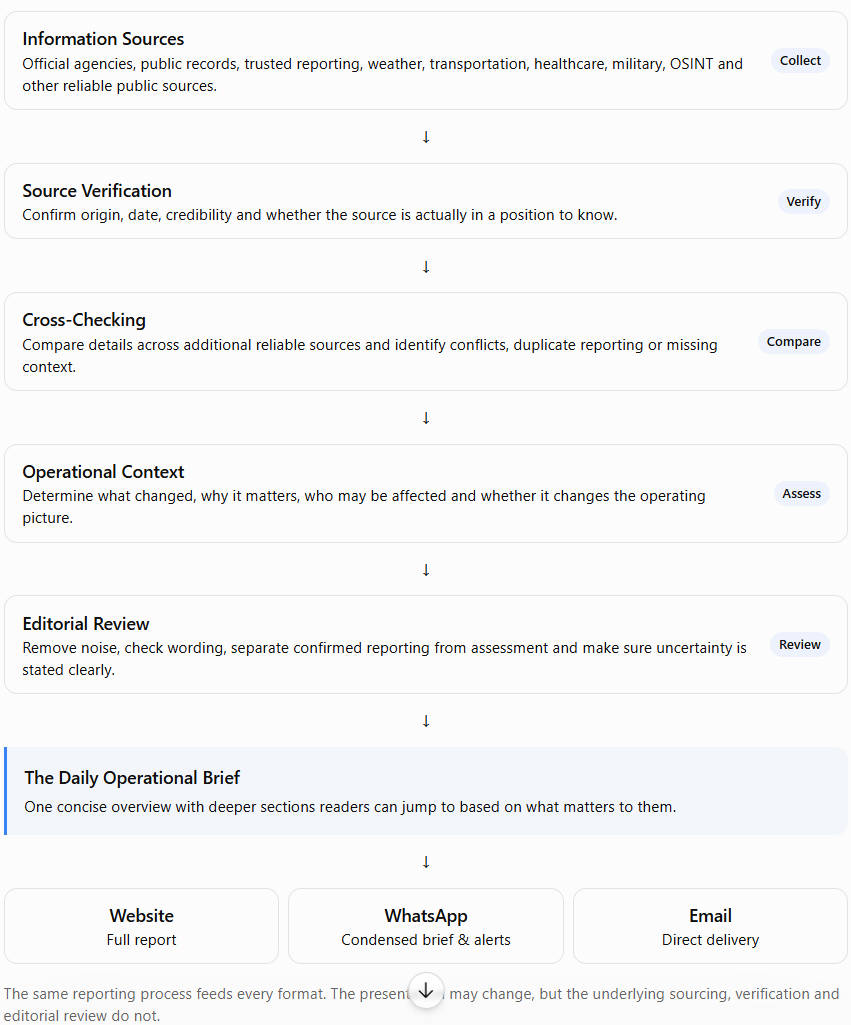
This page explains how I collect, evaluate, organize, verify, and present information before it becomes part of a report.
Where Information Comes From
No single source tells the complete story.
Instead, I build each report by comparing information from multiple reliable sources whenever possible.
Depending on the topic, that may include official government agencies, emergency management organizations, healthcare systems, transportation agencies, weather services, military organizations, public records, court documents, and established news organizations.
When primary information is available, it is generally given greater weight than commentary or secondary reporting.
Types of Sources
- Federal government agencies
- State government agencies
- Local government agencies
- Law enforcement
- Fire & EMS
- Emergency management
- Public health agencies
- National Weather Service
- Transportation agencies
- FAA
- FEMA
- CDC
- Department of Homeland Security
- Department of Defense
- Military public affairs
- Court records
- Public documents
- Utility providers
- Infrastructure operators
- Hospital systems
- Universities
- Local news organizations
- National news organizations
- Professional journals
- Open-source intelligence (OSINT)
- Verified public information
How Information Is Evaluated
Not every piece of information deserves equal confidence.
When reviewing reports, I consider several questions before deciding whether something belongs in the publication.
Where did the information originate?
Has another reliable source confirmed it?
Does supporting evidence exist?
Is the information current?
Could important context be missing?
Does the available evidence support the conclusions being drawn?
Sometimes the correct decision is not to publish something until additional information becomes available.
Open-Source Intelligence
The Daily Operational Brief relies heavily on publicly available information.
Open-source intelligence (OSINT) includes information gathered from publicly accessible sources such as government publications, satellite imagery, public records, transportation data, weather information, official statements, court filings, and verified digital media.
OSINT can provide valuable situational awareness, but it still requires verification and context.
Public availability should never be mistaken for accuracy.
Artificial Intelligence in the Workflow
Artificial intelligence helps me organize information, not replace editorial judgment.
AI may assist with collecting publicly available information, organizing large volumes of reporting, identifying duplicate stories, summarizing lengthy documents, creating timelines, formatting reports, generating different publication formats, and improving workflow efficiency.
Every report is reviewed, edited, and approved before publication.
Final editorial responsibility remains with me.
What Gets Included
The goal is not to report everything.
The goal is to report what matters.
Information is selected based on operational significance, public impact, credibility, relevance, and whether it helps readers better understand the current operating picture.
Some stories receive extensive coverage.
Others may receive only a brief mention.
Some may be intentionally omitted because they add little value or cannot be adequately verified.
What Readers Can Expect
- Clear sourcing whenever practical
- Transparent reporting
- Operational context
- Plain language
- Separation between reporting and assessment
- Regular updates when information changes
- Corrections when necessary
- Respect for uncertainty when facts are still developing
Continuous Improvement
The Daily Operational Brief is intended to evolve.
As new tools, better sources, and improved workflows become available, the reporting process will continue to improve.
The goal is not simply to produce more content.
The goal is to produce better intelligence that is easier to understand, more useful to readers, and worthy of their trust.
Last reviewed: August 2026
This methodology is reviewed periodically and updated as the publication and its reporting process continue to evolve.
See how the process comes together.
Read the latest Daily Operational Brief to see how multiple sources, operational context, and clear analysis become one concise daily report.